 SearchChamp
Signals
Review brand mention candidates, linking authors, and network clustering.
Signals covers three things that aren't links yet, or aren't obvious from the link table.
Brand Mentions
These are DataForSEO keyword candidates, not verified unlinked mentions. A matching word can refer to another business, a person, or unrelated content.
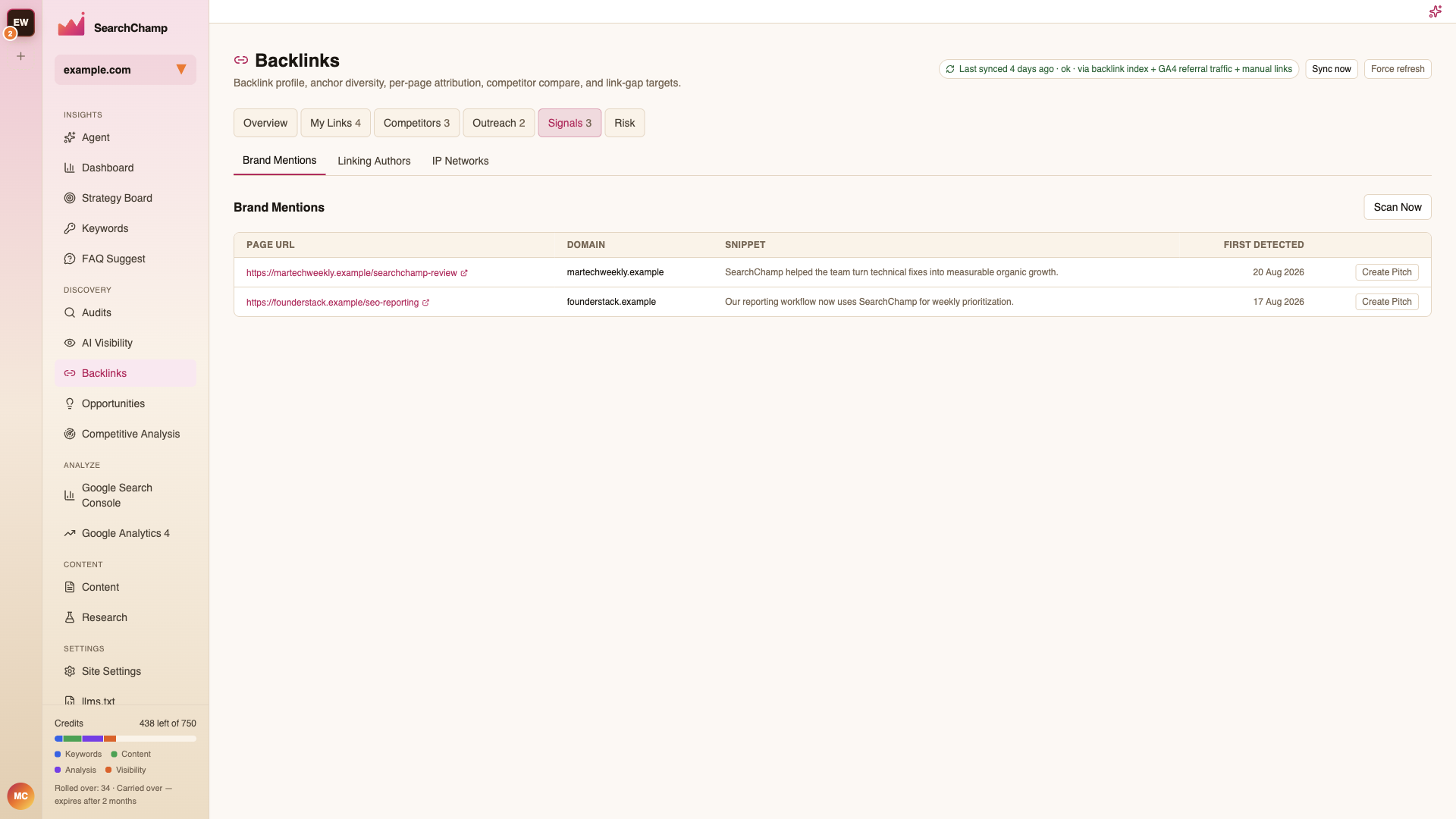
Each row gives the page URL, domain, discovery snippet, and first detected date. Review opportunity opens the shared Opportunity review. Opening it creates no pitch and uses no draft credit. Scan Now discovers candidates; it does not verify every result.
The selected page is checked live and classified as verified relevant and unlinked, verified relevant — existing citation, false positive / not about the brand, or ambiguous / needs review. The matched excerpt and reason explain the result. A literal name without credible business context is not enough. An existing link to the configured official domain or an explicitly configured alias prevents a reclamation pitch.
Historic discovery evidence stays beside the dated live result. Successful checks can be reused for seven days; Re-check live requests a fresh bounded check. Blocked, inaccessible or incomplete pages remain unverified. No alias is guessed.
Linking Authors
The individual writers behind your links, rather than the domains. One journalist who has linked to you twice is a warmer contact than a masthead you've never spoken to.
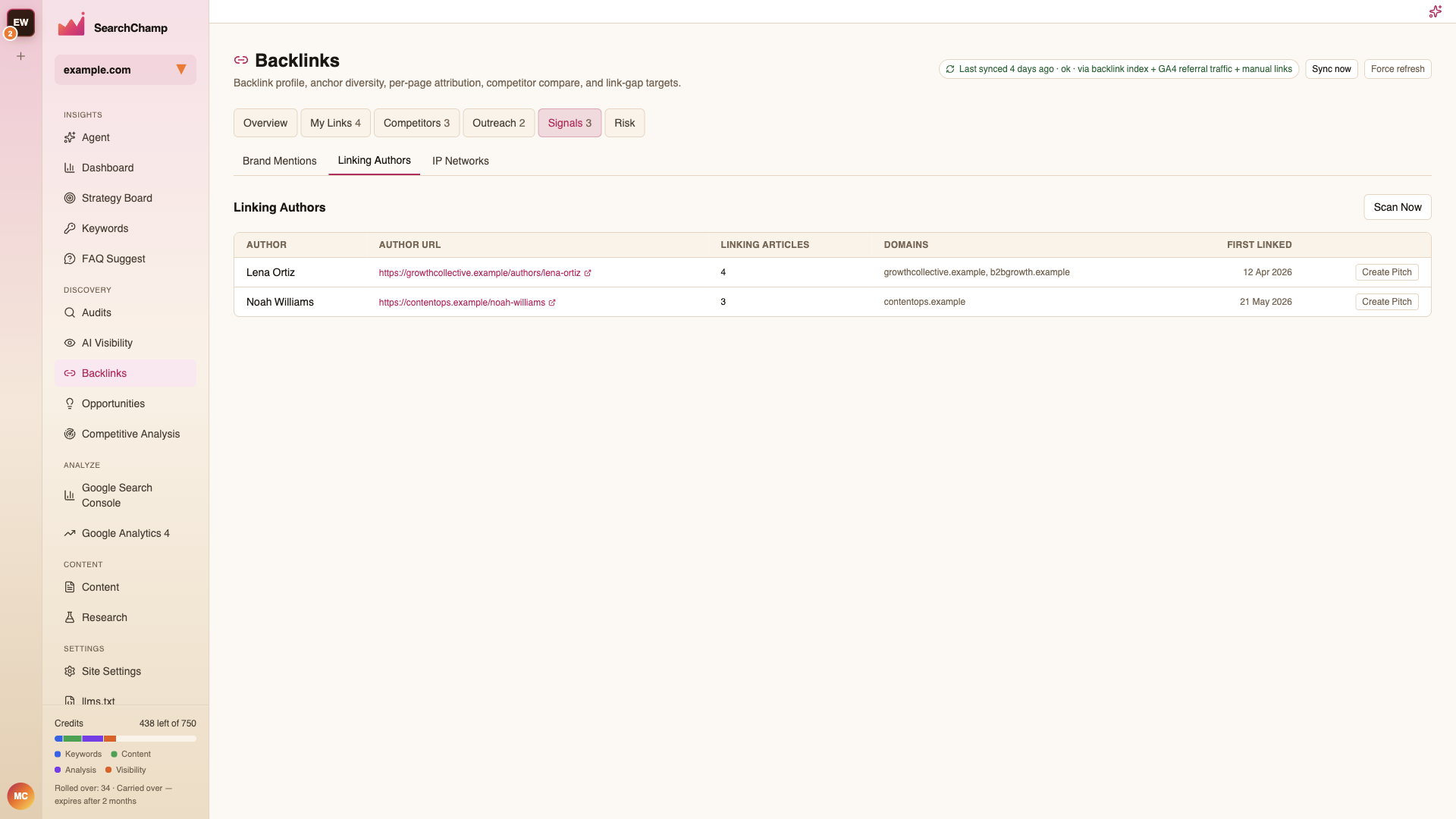
Each row gives the author, their author URL, how many linking articles they've written, the domains they published on, and when they first linked to you. Create Pitch sends them to Outreach as a named contact rather than a generic address. Scan Now re-checks your linking pages for bylines.
A scan reports its own state above the table, because "we have not looked yet" and "we looked and found nobody" are different facts:
| Status | What it means |
|---|---|
| Scan queued | The scan is waiting to start. |
| Scanning your linking pages | It is running now. |
| Last scan finished | It completed, and the counts below are a measurement. |
| Nothing to scan yet | It completed, and this site had no linking pages to read. |
| Last scan did not finish cleanly | It completed, but some pages could not be read. |
| Last scan failed | It did not complete. |
| Last scan stopped before it finished | It was interrupted partway through. |
Counts appear only once a scan has actually measured something. Before that the table says no named authors were found rather than showing zeros, because a zero you have not earned reads as a finding.
IP Networks
Groups your referring domains by the network they're hosted on, so a set of links that sit on one IP range is visible as a set. That can be an old agency's footprint, a previous owner's work, or ordinary shared hosting — the tab shows you the grouping and leaves the judgement to you.
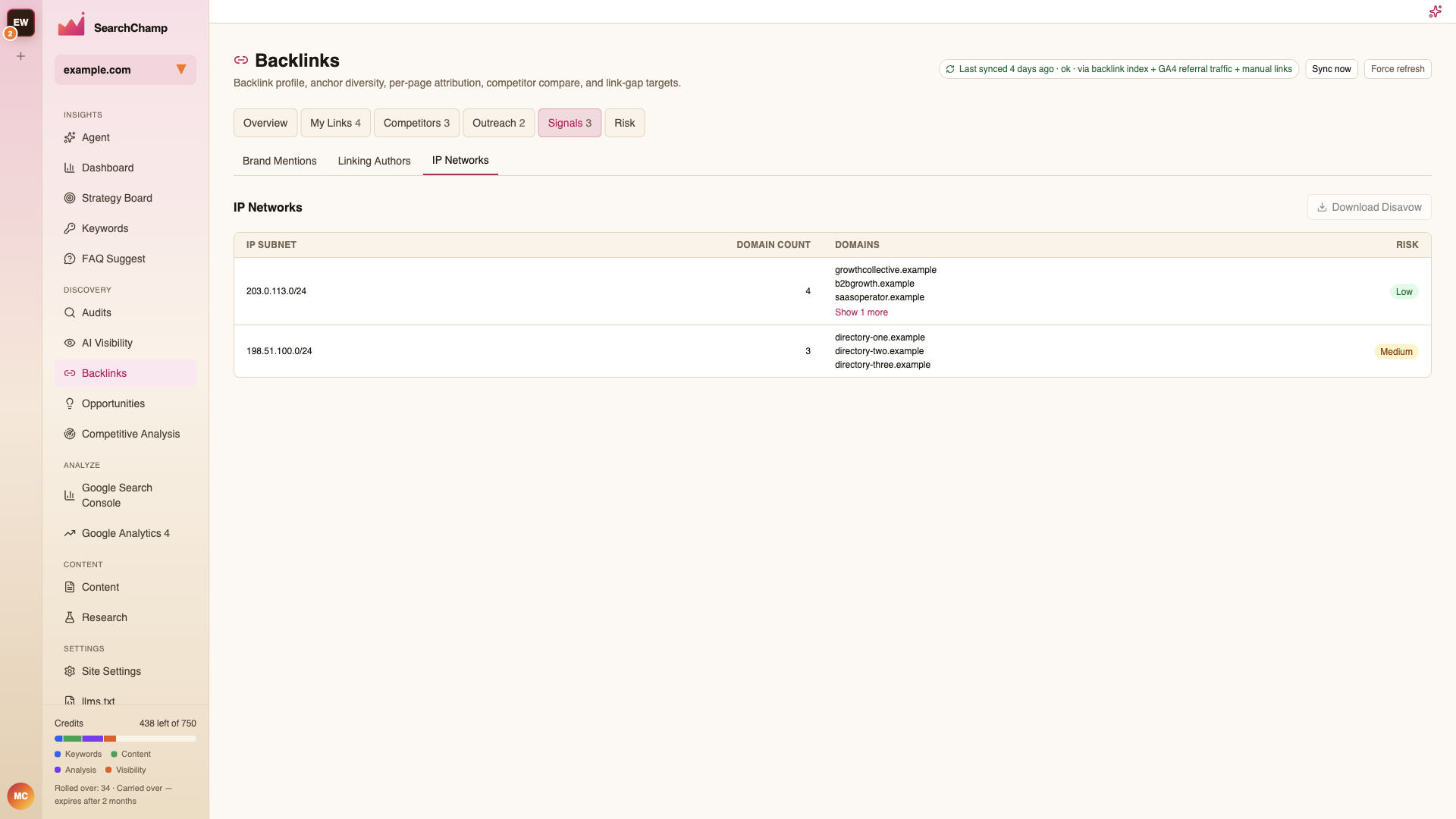
Rows are IP subnet, domain count, the domains themselves, and a review signal: Worth reviewing, Possibly shared, or No signal. The label tells you what to do with the row, not that anything improper has been found.
Above the table, What was checked states how many of your referring domains were checked and how many of their IP addresses resolved, so a short list is never mistaken for a clean result. The tab reports unique IP ranges only when every eligible domain was actually resolved; anything short of that is reported as unverified, with the reason named, rather than as a finding.
The check covers IPv4 address records only, and it can speak only for the domains that were actually checked.