 SearchChamp
Competitive Analysis
Track competitor domains and compare their SEO and AI visibility metrics.
Competitive Analysis tracks the domains you compete with and compares their SEO and AI-visibility metrics against yours. Two tabs: My Competitors and Page Deep Dive.
My Competitors
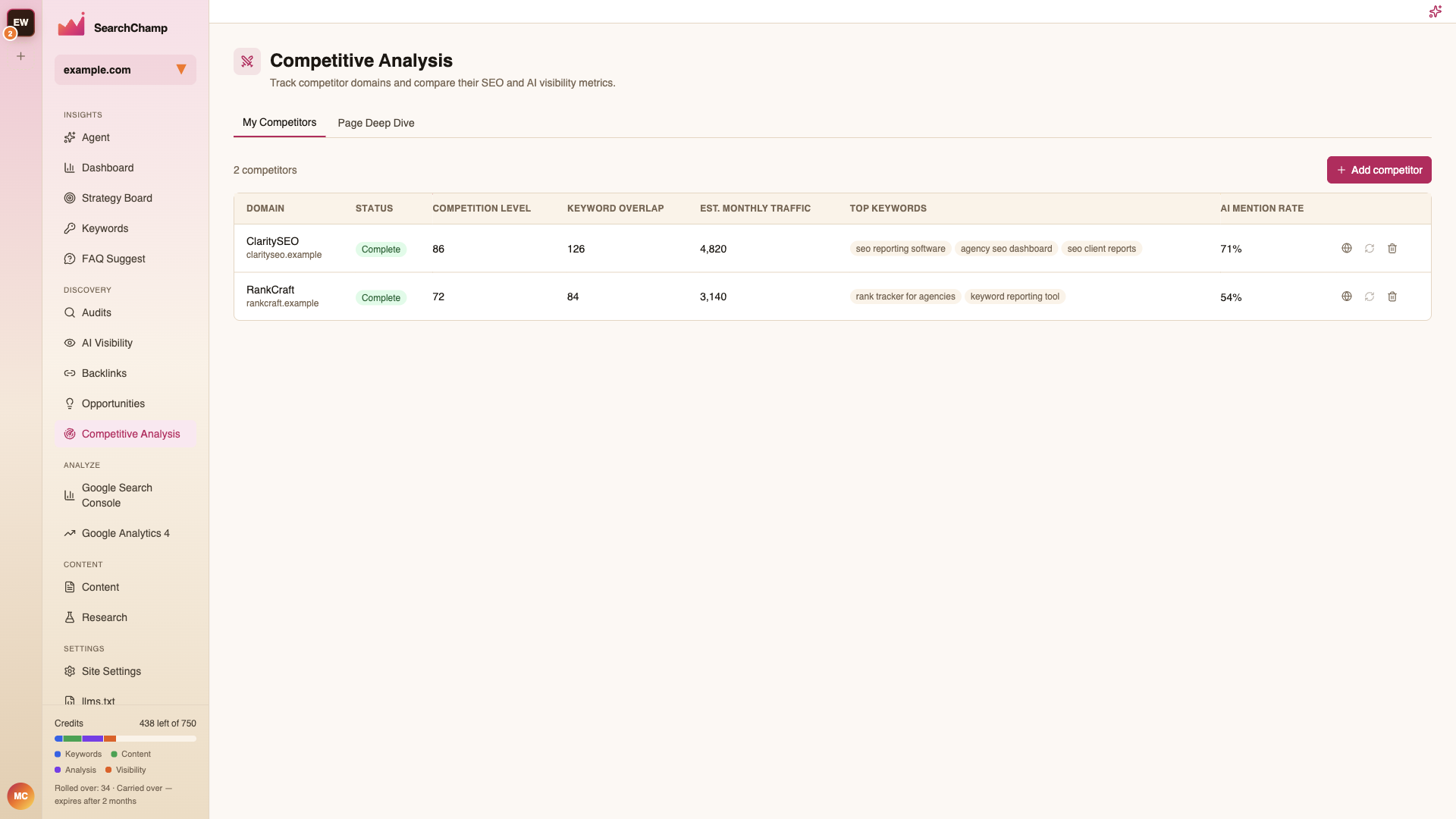
One row per tracked domain:
| Column | Meaning |
|---|---|
| Status | Refresh outcome and provider coverage, with a separate snapshot age and capture date |
| Competition level | 0–100 — how directly this domain competes with you |
| Keyword overlap | How many keywords you both target |
| Est. monthly traffic | Estimated organic traffic to their site |
| Top keywords | The terms they're strongest on |
| AI mention rate | How often AI assistants name them |
Add competitor starts tracking a new domain using a domain or an HTTP/HTTPS URL, optional display name, and target location. Competitive Analysis and Backlinks → Competitor Compare use the same site-level list and the same form. A saved host is normalized and appears once in both surfaces. Invalid, own-site, or already tracked inputs show actionable errors.
Per-row, Refresh re-runs the analysis and Delete stops tracking in both surfaces. Backlinks also offers an explicit individual Scan backlinks action; simply adding a competitor does not spend a backlink-scan credit. Scan and refresh availability follows site permissions and account limits.
Reading status and snapshot age
Refresh succeeded describes the retrieval outcome, not how recent the data is. The table and detail panel separately show the snapshot's capture date. Snapshots at least seven days old are marked stale; a missing or invalid date has unknown age. The capture date does not establish the age of the provider's underlying index. Reusing cached provider data retains its original capture date even when the refresh attempt completes later.
Limited provider coverage means the record has no organic ranking coverage. The reported locale is shown when recorded; an absent locale stays unknown. Missing coverage does not measure domain authority or prove that a site is small or new. Global data identifies a recorded fallback result, not a fallback inferred merely from missing coverage.
Pending work, successful empty retrievals, and Refresh failed remain distinct. Exhausted automatic refresh attempts are failures even when the system has stopped retrying them. Their displayed timestamp records the attempt, not a fresh successful snapshot. Use the existing Refresh control when its cooldown allows; another attempt may still return no coverage.
Totals and estimated traffic come from the provider's aggregate result, rather than the number of keywords returned in a limited list. A missing total or traffic value remains unavailable; a measured zero is displayed as zero. Keyword overlap uses the true intersection count and the whole-index total for the same effective locale.
Competitor detail
Click a competitor to open its detail panel.
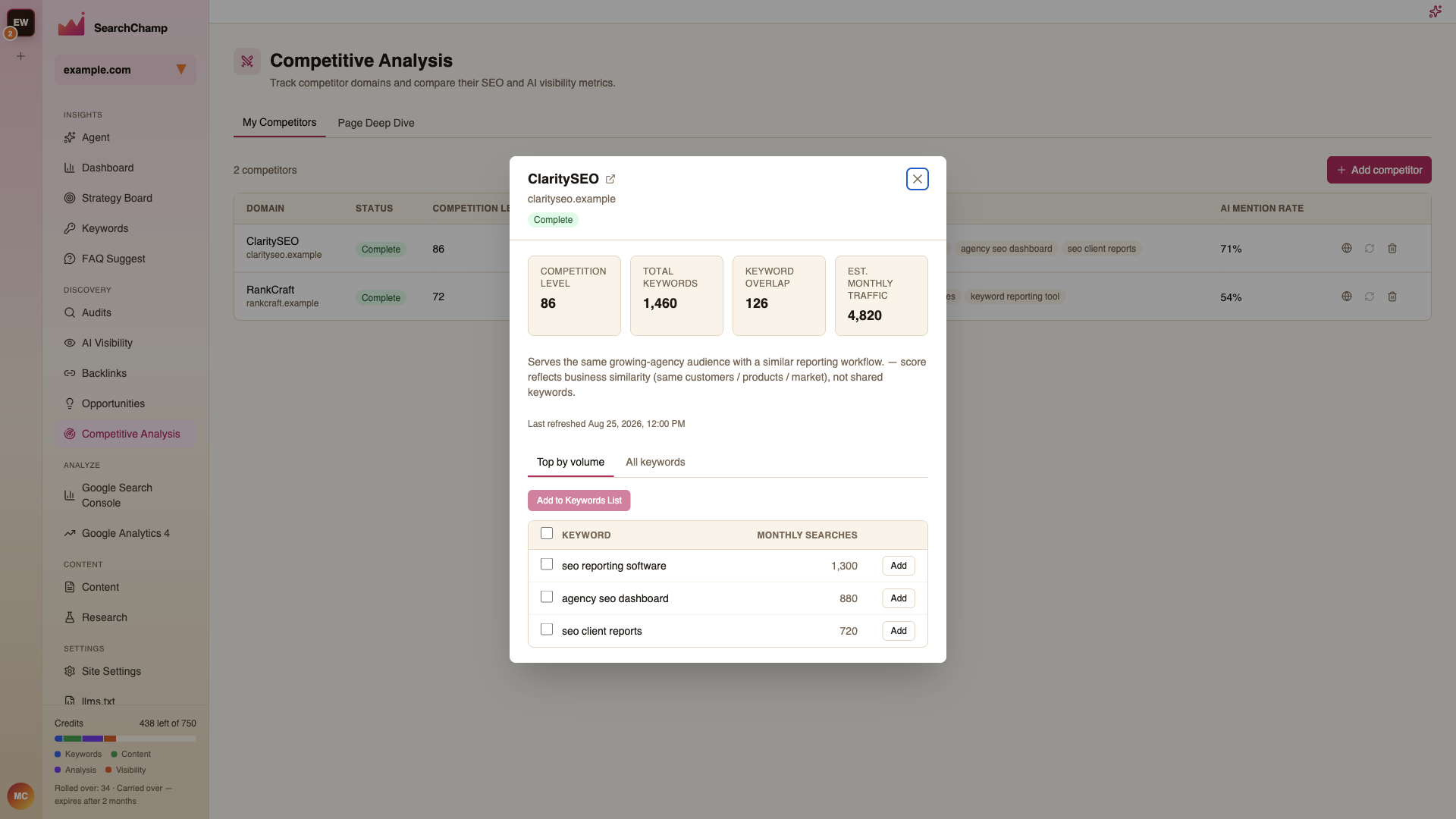
It shows Competition level, Total keywords, Keyword overlap, and Est. monthly traffic, a plain-English explanation of why the score is what it is, and their keywords under two tabs — Top by volume and All keywords.
Related articles
- Page Deep Dive
- Analyze your competitors
- AI Visibility → Competitors — the same question, for AI answers