 SearchChamp
How we measure
Which engines are queried, how, and where the honest limits are.
The How we measure link in the AI Visibility header opens the methodology page: what's collected, which models are queried, how confident a number is, and where the limits are.
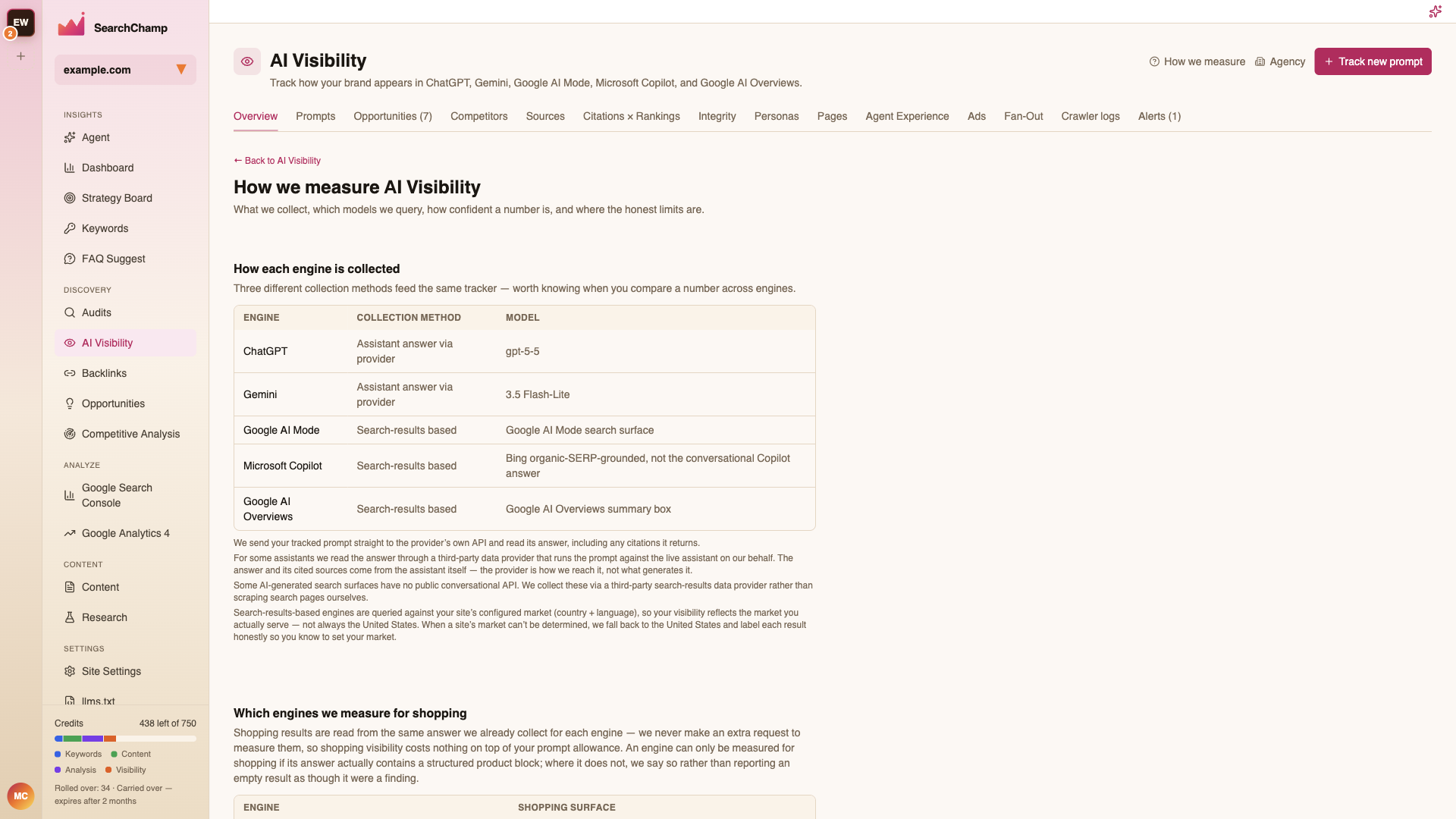
Three collection methods
Not every engine is reached the same way, which matters when you compare a number across engines.
| Engine | Collection method |
|---|---|
| ChatGPT | Assistant answer via provider |
| Gemini | Assistant answer via provider |
| Google AI Mode | Search-results based |
| Microsoft Copilot | Search-results based (Bing organic-SERP-grounded, not the conversational Copilot answer) |
| Google AI Overviews | Search-results based |
| Perplexity | DataForSEO model responses |
- Assistant answer — your prompt goes to the provider's own API and SearchChamp reads the answer and its citations. For some assistants that runs through a third-party data provider against the live assistant; the answer still comes from the assistant itself.
- Search-results based — some AI surfaces have no public conversational API, so they're collected via a third-party search-results provider rather than by scraping search pages.
Search-results-based engines are queried against your site's configured market (country + language), so your visibility reflects the market you actually serve. Where a market can't be determined, results fall back to the United States and are labelled as such.
Perplexity methodology
Perplexity is included on every paid plan. The collection path uses DataForSEO model responses, not the Perplexity consumer interface. A model response cannot establish what a user saw in that consumer product, including its sponsored or shopping placements. Provider and model identity must come from the collected response and its provenance; missing identity stays unknown.
Unknown provider token usage stays unknown; a measured zero stays zero. Missing observations, an unavailable engine and a successfully collected answer with no brand mention are different states. None should be represented by an invented successful result.
A request being accepted does not prove collection finished. A polling deadline expiring does not prove collection finished either. Pending and failed requests are not a completed answer or evidence that your brand was absent. An unknown provider charge is not a zero charge; the collected observation and known accounting evidence must establish the outcome.
Configuration is separate from working tracking
The UI's engine configuration status can include optional provider: "dataforseo_gateway" and configuration_state: "unknown" | "disabled" | "enabled" declarations. Legacy responses may omit these fields. An absent or malformed declaration is unknown; a disabled declaration is unconfigured; exact enabled declares configured. Direct Perplexity keys do not configure the DataForSEO gateway path.
Configuration is not provider health. Registry availability and plan entitlement remain separate checks, along with operational controls and actual results. Each environment declares its own configuration state; a configuration declaration does not authorize tracking by itself.
For client developers, the engine-status route is a site-scoped Cognito UI endpoint requiring Editor+ access. It is not a new API-key or MCP operation. Canonical sample runs use the signed AV-runs FIFO and the same DFS gateway worker as tracked runs, with the same availability and entitlement boundaries.
Shopping
Shopping results are read from the answer already collected for each engine — never a second request — so shopping visibility costs nothing extra against your prompt allowance. An engine is only measured for shopping when its answer genuinely contains a structured product block; where it doesn't, the page says so rather than reporting an empty result as a finding. See AI shopping visibility.
Confidence
Numbers carry their sample size and margin (e.g. n=216 · ±6pp). A small sample is labelled directional rather than presented as precise — read those as a direction of travel, not a measurement.